HowMuchIt / Ounces in a cup
How many ounces in a cup?
Eight: a US cup holds 8 US fluid ounces. The catch is the word ounce, which also means weight, and a cup of flour weighs far less than a cup of water. The converter does the volume; the page explains the rest.
Convert cups and ounces
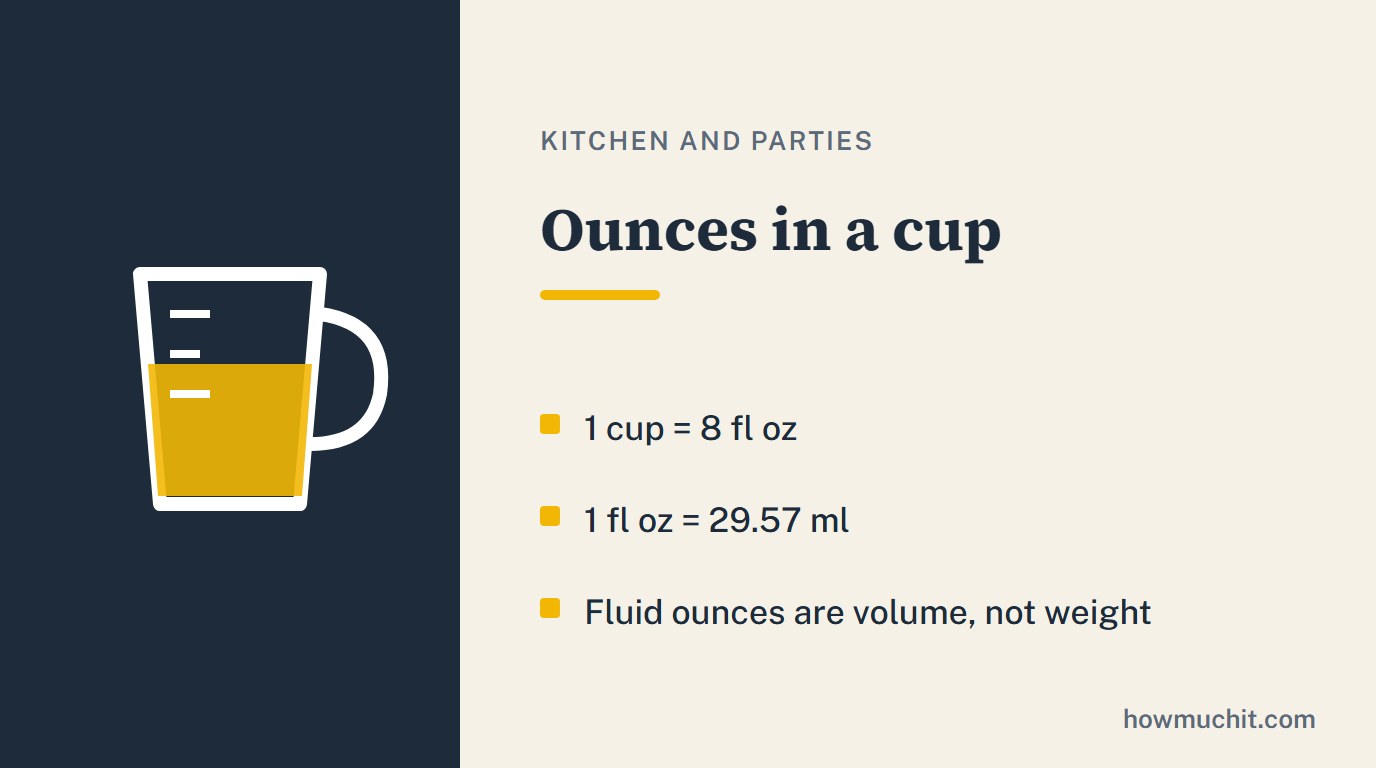
1 US cup = 8 US fluid ounces = about 236.6 ml (nutrition labels use 240 ml). 1 US fluid ounce = 29.57 ml; a UK fluid ounce is 28.41 ml. Fluid ounces measure volume, not weight.
| Cups | Fluid ounces | Tablespoons |
|---|---|---|
| 1/4 | 2 | 4 |
| 1/3 | 2 2/3 | 5 1/3 |
| 1/2 | 4 | 8 |
| 1 | 8 | 16 |
| 2 | 16 | 32 |
Fluid ounces are not weight ounces
A fluid ounce measures space; the ounce on a kitchen scale measures weight. They share a name and almost nothing else. A cup of butter weighs 8 ounces, because a stick is half a cup and weighs 4. A cup of granulated sugar weighs about 7 ounces, and a cup of flour much less. That is why bakers weigh dry ingredients: a scale gives the same answer every time, and a cup does not.
US, metric and UK cups
The US cup is about 236.6 milliliters, and nutrition labels round it to 240. Australia, Canada and New Zealand use a metric cup of 250 ml, a little bigger; in most recipes the two can be swapped. UK fluid ounces are smaller than US ones, 28.41 ml against 29.57, so an old British recipe in ounces runs slightly short in American measures.
Questions people ask
Is a cup 8 ounces of weight?
Only for some things. A cup of water or butter weighs about 8 ounces; a cup of flour or sugar does not.
How many ounces is a coffee cup?
On a drip coffee maker, a "cup" is about 5 fluid ounces, not 8. See the coffee ratio calculator.
Should I measure by weight or by volume?
For dry ingredients, by weight is more reliable. Liquids are fine in a measuring cup.
Good to know
- One US cup holds 8 US fluid ounces.1,2,3
- A US customary cup is about 236.6 milliliters.4,5
- For US nutrition labels a cup is defined as 240 ml, and many guides give the US measuring cup as 240 ml.5,6,7
- Australia, Canada and New Zealand use a metric cup of 250 ml, slightly larger than the US cup; the two can usually be swapped in recipes.5,8
- A fluid ounce measures volume, while the ounce on a scale (avoirdupois ounce) measures weight; they are two different units.8,9
- A US fluid ounce is 29.57 ml.4,9
- A UK (imperial) fluid ounce is smaller: 28.41 ml.4,9
- A stick of butter is 1/2 cup (8 tablespoons) and weighs 4 ounces, so a cup of butter weighs 8 ounces.10,11
- A cup of granulated sugar weighs about 7 ounces (198 g); a pound is about 2 1/4 cups.10,11
- Weighing dry ingredients on a kitchen scale is more reliable than measuring them by the cup.8,10
How we checked this page
Checked on October 27, 2026. We kept a fact only when two independent publishers agree, and each one is numbered to its sources below. Where sources give different numbers, we keep only what they share. We never write a price. This page was written with an AI assistant and checked against the sources below.
Sources
- Measurement Conversions for Recipes (HGIC 4260), Clemson Cooperative Extension
- Measure Up! (4-H Food, Fun), Purdue Extension, Lawrence County
- Cooking Measurement Chart: Common Kitchen Conversions and Equivalents, The Old Farmer's Almanac (Yankee Publishing)
- NIST Guide to the SI, Appendix B.9: Factors for units listed by kind of quantity, NIST
- Cup (unit), Wikipedia (unit definition)
- 21 CFR 101.9 Nutrition labeling of food, eCFR (FDA regulation)
- What's the REAL Rice Cup Size? Aroma Q&A, Aroma Housewares
- Culinary Measurement Tips, NIST Office of Weights and Measures
- Fluid ounce, Wikipedia (unit definition)
- Ingredient Weight Chart, King Arthur Baking
- In a Pinch: Food Yields (MP563), University of Missouri Extension