HowMuchIt / Appliance kWh
How much electricity does my appliance use?
Find the watts on the appliance, estimate the hours it runs each day, and the rest is arithmetic: a kilowatt-hour is 1,000 watts for one hour. Type your rate to see what it costs you.
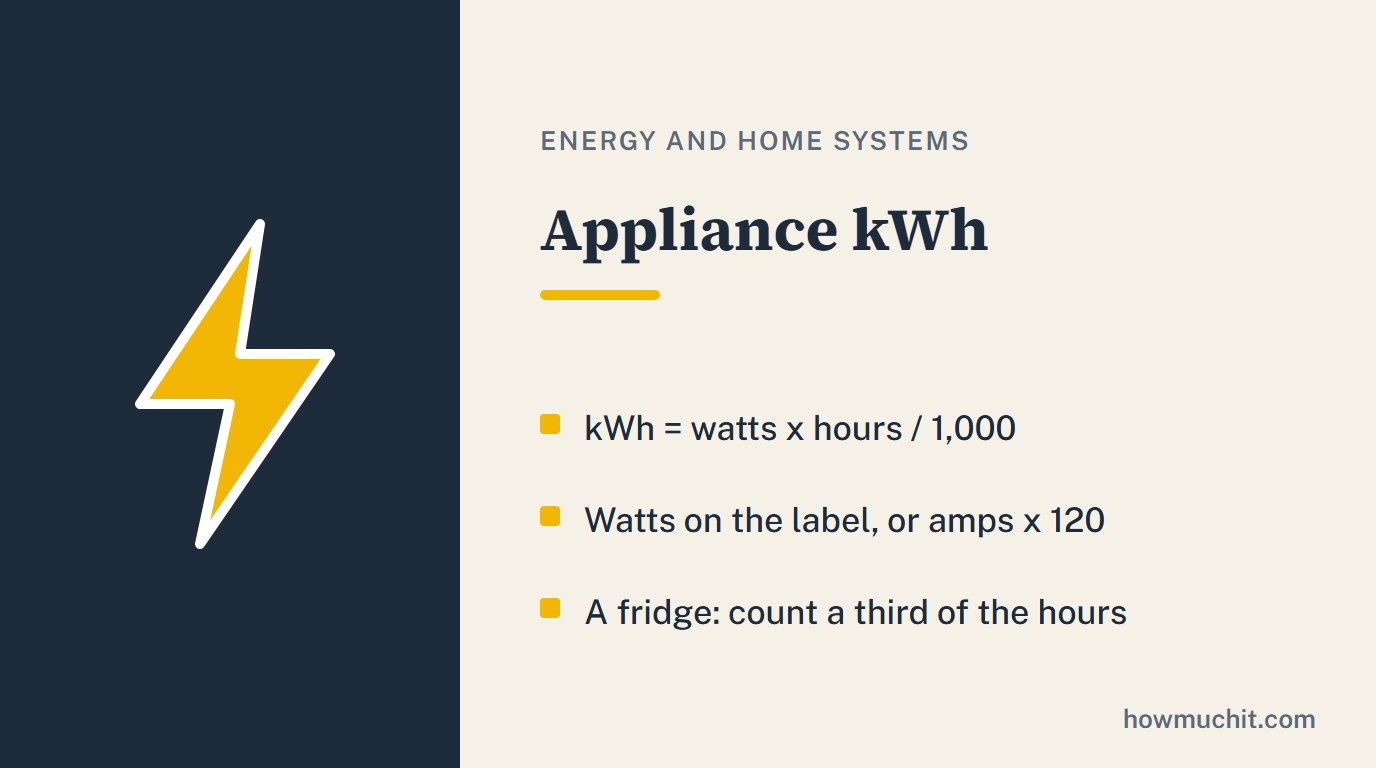
Work out what it uses
| Step | How |
|---|---|
| Watts | on the label; or amps x volts (120 for most US appliances) |
| kWh a day | watts x hours a day / 1,000 |
| kWh a year | kWh a day x days used |
| Microwave | roughly 750 to 1,100 W while running |
| Electric dryer | roughly 1,800 to 5,000 W |
Finding the watts
The wattage is stamped on the bottom or the back of most appliances, or on a nameplate inside the door. If the label only gives amps, multiply by the volts: 120 for most US appliances. The label is the most the appliance draws; the real draw depends on the setting, its age and its features, so treat the result as a good guide. To know exactly, plug the appliance into an electricity usage monitor, a small meter that sits between the plug and the outlet.
Fridges, standby and the big users
A refrigerator runs its compressor on and off all day, so count about a third of the hours it is plugged in; tick the box and the calculator does it. Many devices keep drawing a little power when switched off, called standby or phantom power: a power strip with a switch stops it. Heat makes the big numbers: a clothes dryer can draw 1,800 to 5,000 watts while it runs, a microwave 750 to 1,100.
Questions people ask
How do I estimate what an appliance uses?
Watts times hours a day, divided by 1,000, gives kWh a day. A 100 watt TV on for 5 hours uses 0.5 kWh a day, about 183 a year.
What if the label has no watts?
Multiply the amps by the volts. Or measure it with a plug-in usage monitor.
Do appliances use power when they are off?
Many do, in standby. Unplug them or use a switched power strip.
Good to know
- One kilowatt-hour (kWh) is 1,000 watts used for one hour.1,2
- Daily kWh = watts x hours used per day / 1,000.2,3
- Yearly kWh = daily kWh x the number of days the appliance is used in a year.2,3
- Find the wattage stamped on the bottom or back of the appliance, or on its nameplate.2,3
- If only amps are listed, multiply amps by volts; most US appliances use 120 volts.2,3
- A refrigerator cycles on and off, so count about one third of the hours it is plugged in.2,3
- Real draw depends on the setting, age and features, so the listed wattage is a guide, not an exact use.2,3
- A microwave oven draws roughly 750 to 1,100 watts while running.2,4
- An electric clothes dryer draws roughly 1,800 to 5,000 watts.2,4
- Many devices still draw standby ("phantom") power when switched off; unplug them or use a power strip switch.2,3
- To measure one appliance directly, plug it into an electricity usage monitor (watt meter).3,4
How we checked this page
Checked on October 27, 2026. We kept a fact only when two independent publishers agree, and each one is numbered to its sources below. Where sources give different numbers, we keep only what they share. We never write a price. This page was written with an AI assistant and checked against the sources below.
Sources
- Measuring electricity, U.S. Energy Information Administration
- Energy Series: Estimating Appliance and Home Electronic Energy Use, Virginia Cooperative Extension (Virginia Tech)
- Estimating Appliance and Home Electronic Energy Use, U.S. Department of Energy (Energy Saver)
- How much electricity does an American home use?, EnergyBot