HowMuchIt / Breaker and wire
What size breaker and wire do I need?
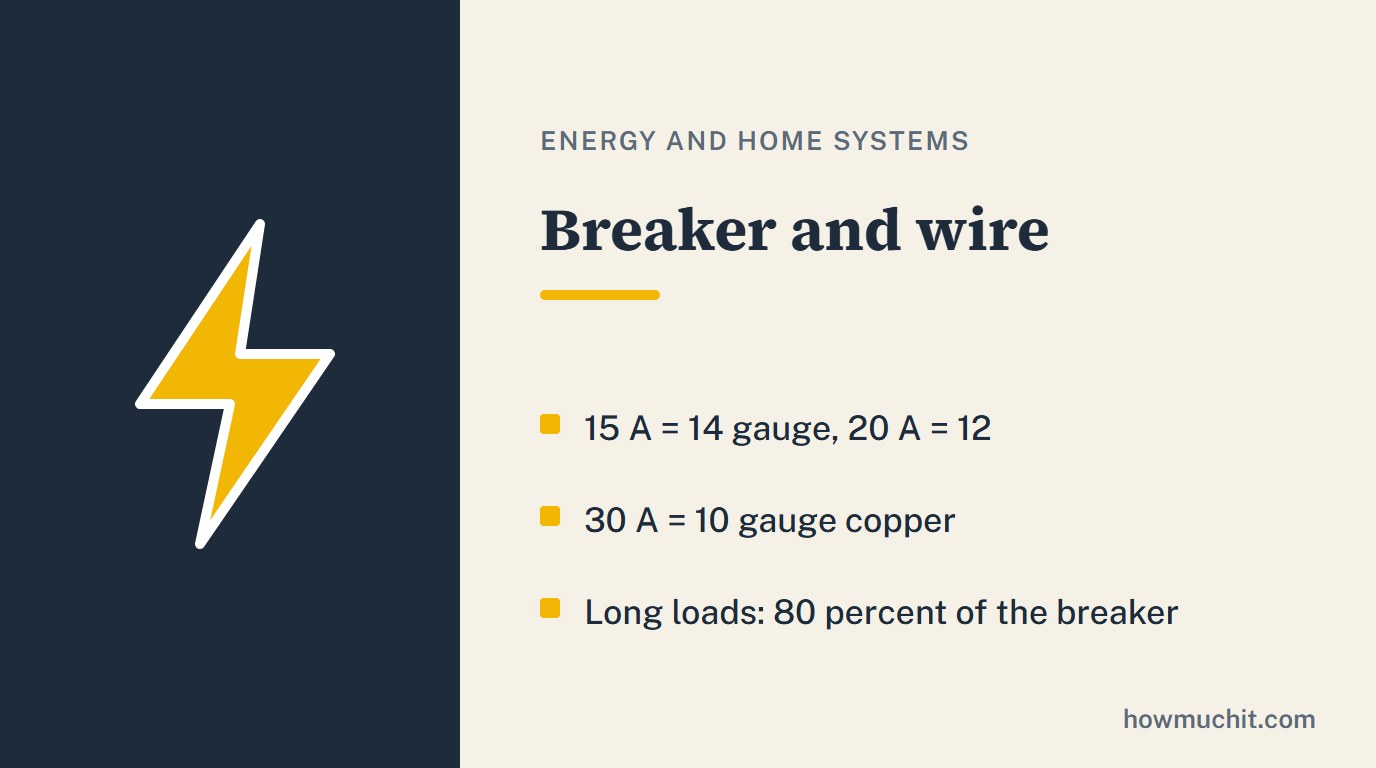
A breaker protects the wire behind the wall, so the two go together: 15 amps with 14-gauge copper, 20 with 12, 30 with 10. The calculator turns your load into amps and finds the pair it needs.
Work out your breaker and wire
| Wire | Breaker | Typical use |
|---|---|---|
| 14 gauge | 15 A | lighting and outlets |
| 12 gauge | 20 A | kitchen and laundry circuits |
| 10 gauge | 30 A | dryers and air conditioners |
Long-running loads stay under 80 percent of the breaker: 16 A on a 20 A breaker. Watts = volts x amps. A licensed electrician adds or changes any circuit.
From watts to amps
Watts equal volts times amps. Most US outlets are 120 volts, so a 1,500 watt heater draws 12.5 amps; on a 240 volt circuit, the same watts draw half the amps. The appliance label gives the watts or the amps. A load that runs for hours at a time, like a heater, should stay under 80 percent of the breaker: 16 amps on a 20 amp breaker, 12 on a 15. That is why a 12.5 amp heater belongs on a 20 amp circuit.
Wire and breaker are a pair
Never put a bigger breaker on a wire to stop it tripping: the breaker is there so the wire does not overheat. In the common NM-B cable, 14-gauge copper goes with 15 amps, 12-gauge with 20 and 10-gauge with 30; 6-gauge is rated 55 amps in that column. Adding or changing a circuit is a job for a licensed electrician, with a permit where your town asks for one.
Questions people ask
What gauge wire for a 20 amp breaker?
12-gauge copper. A 15 amp breaker takes 14-gauge, a 30 amp takes 10-gauge.
Can a space heater share a 15 amp circuit?
A 1,500 watt heater draws 12.5 amps, more than 80 percent of 15 amps, so it is better on its own 20 amp circuit.
What happens with the wrong wire size?
Wire too thin for its breaker can overheat before the breaker trips. That is the one mistake the pairing exists to prevent.
Good to know
- 14-gauge copper wire goes with a 15-amp breaker.1,2
- 12-gauge copper wire goes with a 20-amp breaker.1,2,3
- 10-gauge copper wire goes with a 30-amp breaker.1,2
- 6-gauge copper wire is rated 55 amps in the common 60 deg C (NM-B cable) column.1,2
- Typical uses: 14-gauge for lighting and outlets, 12-gauge for kitchen and laundry circuits, 10-gauge for dryers and air conditioners.1,3
- Do not load a circuit past 80 percent of its rating for long-running loads (16 amps on a 20-amp breaker).1,3,4
- Watts = volts x amps; most US household outlets are 120 volts, so 3 amps is about 360 watts.5,6
- Have a licensed electrician add or change any circuit.2,3,4
How we checked this page
Checked on October 27, 2026. We kept a fact only when two independent publishers agree, and each one is numbered to its sources below. Where sources give different numbers, we keep only what they share. We never write a price. This page was written with an AI assistant and checked against the sources below.
Sources
- How to Read a Wire Gauge Chart, The Home Depot
- Ampacity Charts, Cerrowire
- How To Use a Wire Gauge Amp Chart, Angi
- Understanding Wire Size Amperage Charts for Safe Wiring, Anker SOLIX
- Estimating Appliance and Home Electronic Energy Use, U.S. Department of Energy (Energy Saver)
- Energy Series: Estimating Appliance and Home Electronic Energy Use, Virginia Cooperative Extension (Virginia Tech)