HowMuchIt / Fertilizer
How much fertilizer do I need?
The first number on the bag is the percent of nitrogen. Divide 100 by it and you get the pounds of product that put 1 pound of nitrogen on 1,000 square feet; the calculator scales it to your lawn.
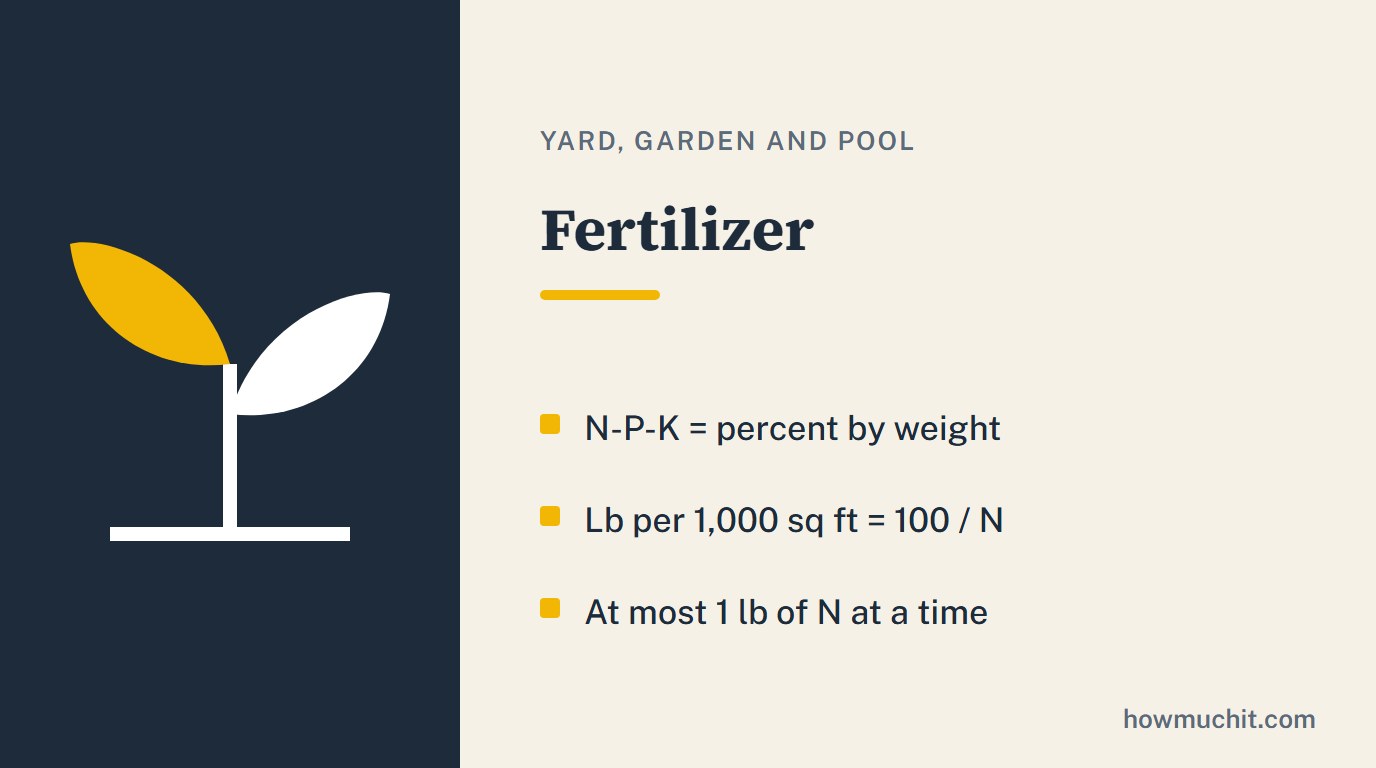
Work out your fertilizer
Pounds of product per 1,000 sq ft for 1 lb of nitrogen = 100 / the first number: 6.25 lb of a 16-4-8. Never more than 1 lb of nitrogen per 1,000 sq ft at one time. The spreader setting is printed on the bag.
Reading the bag
The three numbers, N-P-K, are the percent by weight of nitrogen, phosphate and potash. A 50 pound bag of 10-6-4 holds 5 pounds of nitrogen. A typical single feeding is up to 1 pound of nitrogen per 1,000 square feet, and never more than that at one time. The spreader setting for each spreader model is printed on the bag; if yours is not listed, calibrate it over a measured area.
Keep it on the lawn
Do not fertilize when heavy rain is coming: it washes off as runoff. Sweep anything that lands on the driveway or sidewalk back onto the grass, and keep a broadcast spreader away from water, roads and pavement.
Questions people ask
How much 16-4-8 for 5,000 sq ft?
6.25 lb per 1,000 sq ft: about 31 pounds for one feeding.
What do the three numbers mean?
Percent of nitrogen, phosphate and potash, by weight.
Good to know
- The three numbers on a fertilizer bag (N-P-K) are the percent by weight of nitrogen, phosphate and potash; a 50 lb bag of 10-6-4 holds 5 lb of nitrogen.1,2,3
- Pounds of product per 1,000 sq ft to apply 1 lb of nitrogen = 100 divided by the first number on the bag (for 16-4-8: 100 / 16 = 6.25 lb).1,3,4
- A typical single feeding is up to 1 lb of nitrogen per 1,000 sq ft; never apply more than 1 lb of nitrogen per 1,000 sq ft at one time.2,3,5,6
- Do not fertilize when heavy rain is expected; it can wash the fertilizer away as runoff.2,6,7
- Sweep any fertilizer that lands on a driveway or sidewalk back onto the lawn right away.2,6,7
- Keep rotary (broadcast) spreaders away from water and from roads, driveways and sidewalks.2,7
- The spreader setting for each spreader model is printed on the fertilizer bag; use that number.8,9
- If your spreader is not listed on the bag, calibrate it: spread a known amount over a measured area and adjust the dial until it matches the label rate.7,8,9
How we checked this page
Checked on October 27, 2026. We kept a fact only when two independent publishers agree, and each one is numbered to its sources below. Where sources give different numbers, we keep only what they share. We never write a price. This page was written with an AI assistant and checked against the sources below.
Sources
- Extension Gardener Handbook, 9. Lawns, NC State Extension
- Getting the most out of your lawn soil test report, Cornell University CALS, School of Integrative Plant Science, Horticulture Section
- Fertilizing Lawns (HGIC 1201), Clemson Cooperative Extension, Home and Garden Information Center
- Calculations Used to Determine the Amount of Fertilizer Needed to Treat Turf, Penn State Extension
- Suggested Fertilizer Practices for Lawns (Dawn Pettinelli), UConn Soil Nutrient Analysis Laboratory
- Caring for Your Lawn and the Environment (AG-597), NC State Extension
- Healthy Lawns, Clean Water: fertilizer application, Suffolk County, NY, Division of Water Quality Improvement (local government)
- How to Calibrate a Spreader and Find the Right Settings, ScottsMiracle-Gro
- How to Use a Broadcast Spreader, The Good Earth Garden Center (Little Rock, AR)