HowMuchIt / Grass seed
How much grass seed do I need?
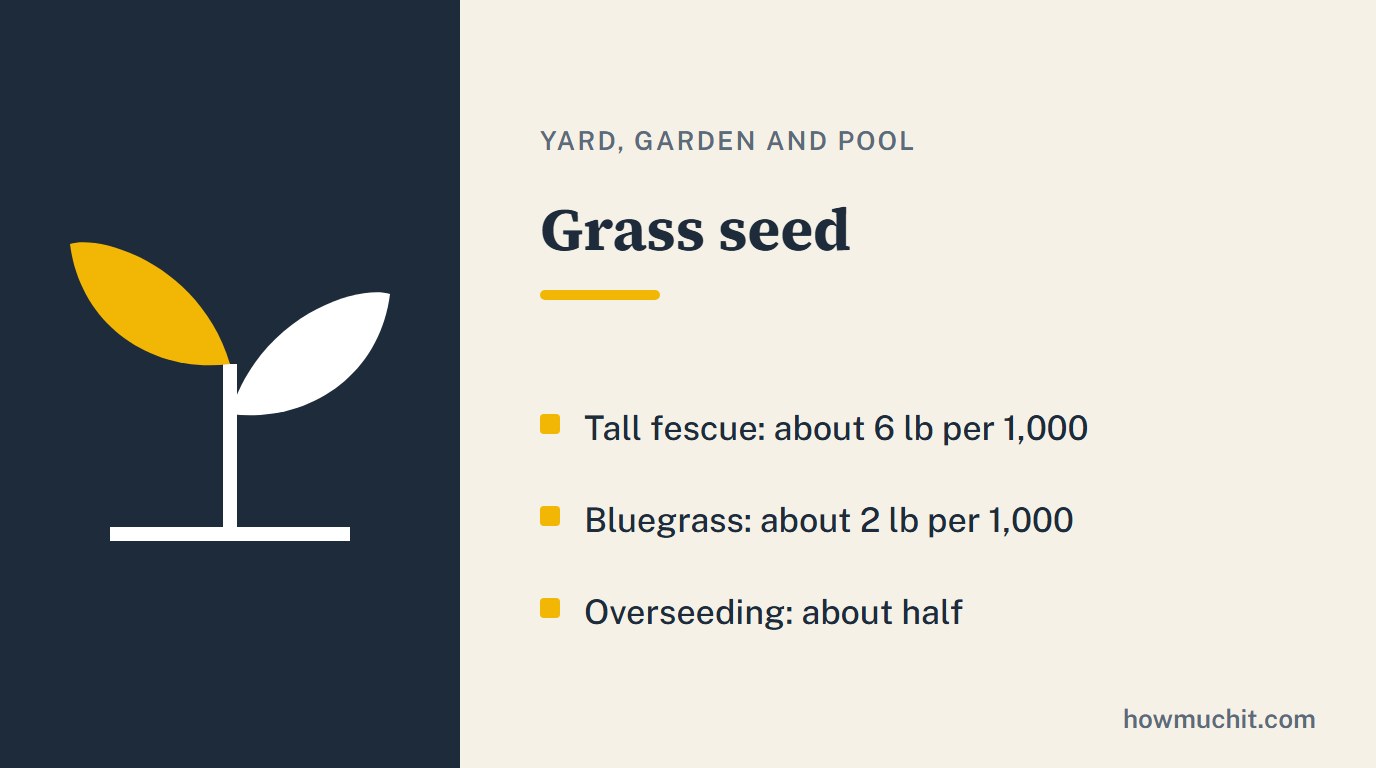
Seed is spread in pounds per 1,000 square feet, and the rate depends on the grass: about 6 for tall fescue, about 2 for Kentucky bluegrass. Overseeding a thin lawn takes about half.
Work out your grass seed
| Grass | Lb per 1,000 sq ft |
|---|---|
| Tall fescue | about 6 (guides: 5 to 8) |
| Kentucky bluegrass | about 2 (1 to 3) |
| Fine fescue | 4 to 6 |
| Bermudagrass, hulled | 1 to 2 |
For fine fescue and bermudagrass the calculator uses the middle of the range (5 and 1.5).
Why the rates differ so much
Seeds are not the same size. Tall fescue seed is big, so it takes about 6 pounds to cover 1,000 square feet of bare ground; extension guides range from 5 to 8. Kentucky bluegrass seed is tiny, and about 2 pounds does the same job. Overseeding into an existing lawn needs less seed than starting from bare ground: about half the new-lawn rate is the figure the guides share.
Questions people ask
How much seed for 5,000 sq ft of tall fescue?
About 30 pounds for a new lawn, 15 to overseed.
How much seed to overseed bluegrass?
About half the new rate: roughly 1 pound per 1,000 sq ft.
Good to know
- A new tall fescue lawn is sown at about 6 pounds of seed per 1,000 sq ft; extension guides give ranges from 5 to 8 pounds.1,2,3
- Kentucky bluegrass needs far less seed: about 2 pounds per 1,000 sq ft for a new lawn (guides range from 1 to 3).1,2,4
- Bermudagrass is sown at 1 to 2 pounds of hulled seed per 1,000 sq ft.2,5
- Fine fescue is sown at about 4 to 6 pounds per 1,000 sq ft.4,6
- Overseeding into an existing lawn takes less seed than starting bare ground: about half the new-lawn rate is the figure the guides share.1,7,8
- Seed rates are stated in pounds of seed per 1,000 sq ft of lawn, so pounds needed = (lawn area in sq ft / 1,000) x rate.2,3
How we checked this page
Checked on October 27, 2026. We kept a fact only when two independent publishers agree, and each one is numbered to its sources below. Where sources give different numbers, we keep only what they share. We never write a price. This page was written with an AI assistant and checked against the sources below.
Sources
- Fall Turfgrass Recommendations and Tips (K-State Turf and Landscape newsletter, 2019), Kansas State University Research and Extension
- Extension Gardener Handbook, 9. Lawns, NC State Extension
- Early fall is ideal for seeding tall fescue lawns, UGA Cooperative Extension (Fannin and Gilmer counties)
- Seeding Your Lawn (Fact Sheet FS584), Rutgers Cooperative Extension
- Bermudagrass for Florida Lawns (ENH19/LH007), UF/IFAS Extension
- Planting and maintaining a fine fescue lawn, University of Minnesota Extension
- Carolina Lawns: A Guide to Maintaining Quality Turf in the Landscape, NC State Extension
- seeding rate for lawn overseeding (#824923), Ask Extension (Extension Foundation)