HowMuchIt / Gravel
How much gravel do I need?
Measure the length and width, choose the depth, and divide the cubic feet by 27 to get cubic yards. If your supplier sells by the ton, type its weight per yard: it changes with the stone.
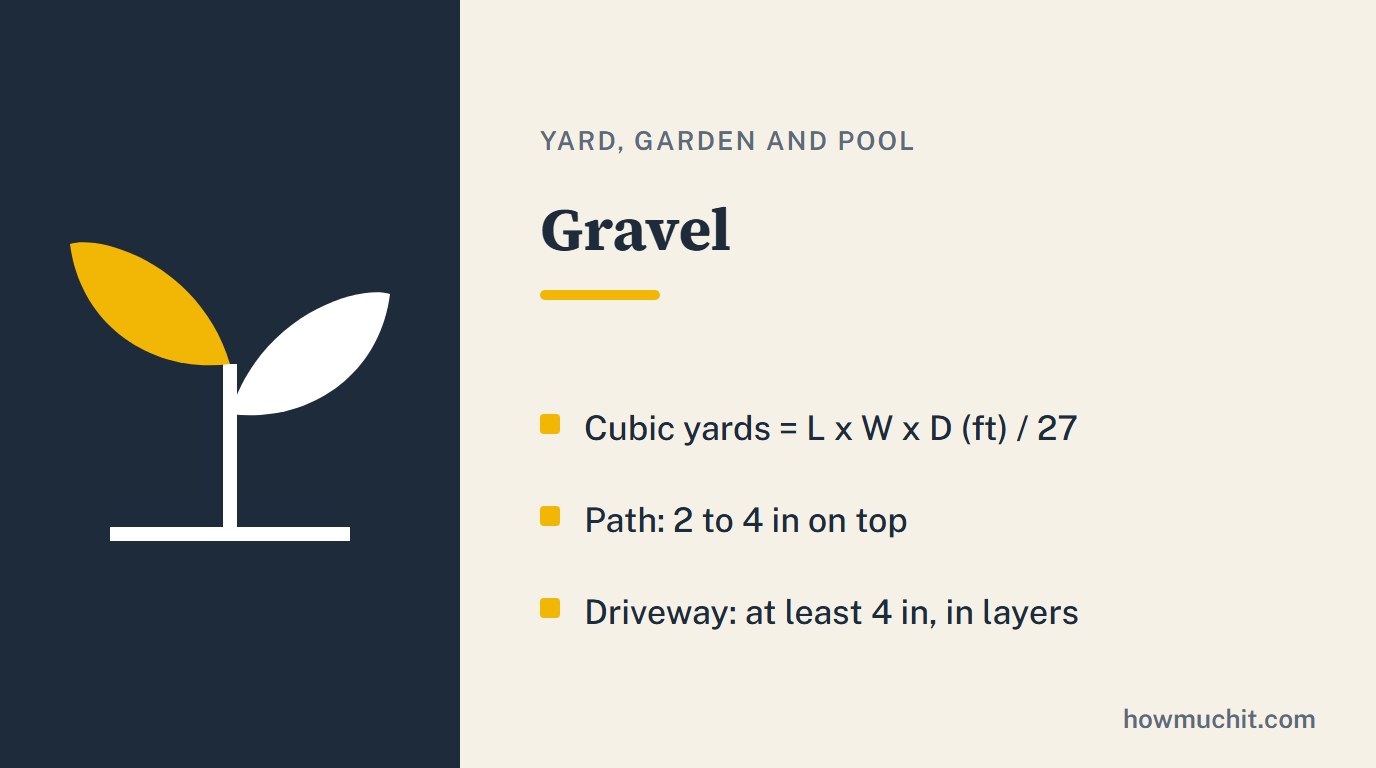
Work out your gravel
| Job | Depth |
|---|---|
| Garden path | 2 to 4 in on top (under 2 lets weeds through) |
| Home driveway | at least 4 in, about 4 to 6 for cars, in compacted layers |
Cubic yards = length x width x depth in feet / 27. Gravel is sold by the yard or by the ton: the weight of a yard changes with the stone, so ask your supplier.
Pick the stone
Pea gravel is small and rounded: it suits walkways, patios and play areas, but it scatters and needs more upkeep. Crushed stone has sharp edges that lock together, so it stays put; it is the usual choice for driveways and for the base under patios and paths. Landscape fabric underneath keeps the gravel apart from the soil and slows the weeds.
Depth and layers
A garden path needs 2 to 4 inches on top: less than 2 lets weeds through. A home driveway needs at least 4 inches, about 4 to 6 for ordinary cars and more for heavy vehicles, built in layers and compacted one at a time with a plate compactor, a roller or a hand tamper. Order a little more than the calculation.
Questions people ask
How much gravel for a 50 x 10 driveway?
At 4 inches, about 6.2 cubic yards.
By the yard or by the ton?
Both exist: ask your supplier how much a yard of its stone weighs.
Good to know
- Cubic yards = length x width x depth, all in feet, divided by 27, because one cubic yard is 27 cubic feet.1,2,3,4,5
- Convert the depth from inches to feet (divide by 12) before you multiply.1,3
- Gravel is sold either by volume (cubic yards) or by weight (tons), so check which unit your supplier uses.6,7
- A gravel path needs a top layer of about 2 to 4 inches; under 2 inches lets weeds come through.3,8
- A home gravel driveway needs at least 4 inches of gravel (about 4 to 6 inches for ordinary cars, more for heavy vehicles), built in layers.7,9
- Compact each layer as you go, with a plate compactor, roller or hand tamper.8,9,10
- Pea gravel is small, rounded stone that suits walkways, patios and play areas.6,11
- Crushed stone has sharp, angular edges, so it stays put better; it is the usual choice for driveways and for the base under patios and paths.3,6,11
- Pea gravel scatters and migrates more than angular gravel, so it needs more upkeep.1,7
- Landscape fabric under the gravel keeps it apart from the soil and slows weeds.3,6,8
- Order a little more than the calculated amount.2,3
How we checked this page
Checked on October 27, 2026. We kept a fact only when two independent publishers agree, and each one is numbered to its sources below. Where sources give different numbers, we keep only what they share. We never write a price. This page was written with an AI assistant and checked against the sources below.
Sources
- Gravel Calculator: How Much Gravel Do I Need?, Angi
- Gravel Calculator - Estimate Yards and Tons, Inch Calculator
- 5 Steps to a Successful Gravel Path (Frank Hyman), Fine Gardening
- CADC Construction Glossary: Cubic Yard, Auburn University
- How Much Mulch Do I Need?, Bob Vila
- Types of Landscaping Rocks and How To Use Them, This Old House
- How Much Does a Gravel Driveway Cost? (non-price passages only), Bob Vila
- Lay Your Own Path, Garden Design
- Proper Gravel Depth Requirements for Different Types of Louisiana Driveways, Port Aggregates
- Create a DIY Pea Gravel Patio, This Old House
- Choosing the Right Sand and Gravel for Your Residential Project, Port Aggregates