HowMuchIt / Pool chlorine
How much chlorine does my pool need?
Two numbers decide it: how many gallons the pool holds, and how far your test reading is from the target of 1 to 3 ppm free chlorine. The calculator works out both, for liquid chlorine, granules and tablets.
Work out your chlorine
| Product | Amount |
|---|---|
| Liquid chlorine, 12 to 12.5 percent | about 10 to 11 fl oz |
| Cal-hypo granules, 67 to 70 percent | about 2 oz |
| 3-inch trichlor tablets (feeder) | about 1 tablet per 5,000 gallons |
Gallons: rectangle = length x width x average depth x 7.5; round = diameter x diameter x average depth x 5.9; oval = long x short diameter x average depth x 5.9. The product label wins over any chart.
How many gallons?
Measure the pool in feet. For a pool with a shallow end and a deep end, average the two depths. A rectangle holds length times width times average depth times 7.5 gallons; a round pool, diameter times diameter times depth times 5.9. A 32 by 16 foot pool, 3 1/2 to 8 feet deep, holds about 22,000 gallons. If the builder or the liner maker gave you the gallons, type them instead.
The target, and the pH that goes with it
Keep free chlorine at 1 ppm or more at all times, and aim for 1 to 3 at home; up to 4 now and then is fine. Keep the pH around 7.2 to 7.6: chlorine works less well as the pH climbs, and much less above 8. A shock is a big one-time dose, about 10 ppm: a little over 3 quarts of 12.5 percent liquid chlorine for 10,000 gallons.
Safety, every time
- Never mix pool chemicals with each other, not even old and new of the same kind: it can cause fire or toxic gas.
- Add the chemical to the water, never water to the chemical.
- Wear goggles and chemical-resistant gloves; store chemicals cool, dry, ventilated and out of the sun.
- Follow the product label: strengths vary, and the label dose wins.
Questions people ask
How much liquid chlorine raises 1 ppm?
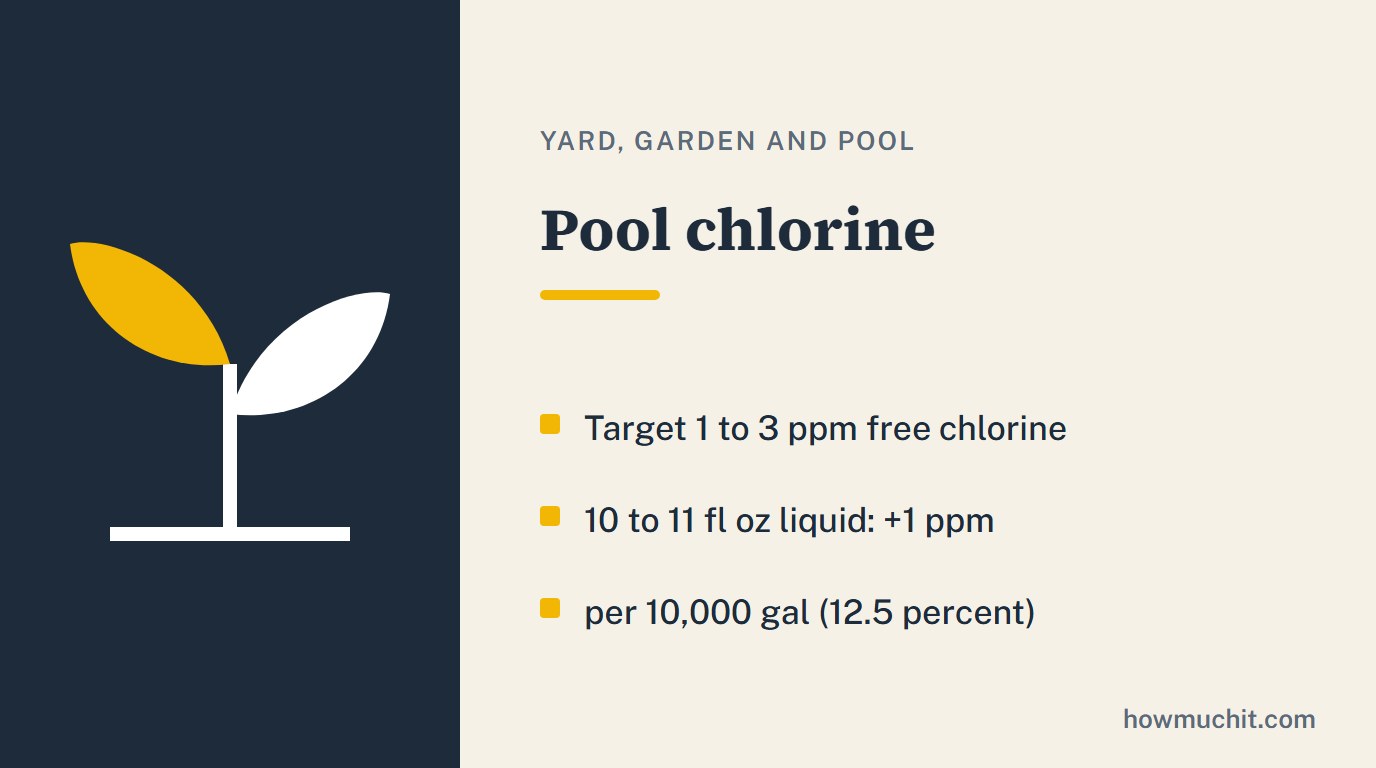
About 10 to 11 fluid ounces of 12 to 12.5 percent liquid chlorine per 10,000 gallons.
How many chlorine tablets for my pool?
About one 3-inch tablet per 5,000 gallons in a feeder or floater: 1 to 2 for 10,000 gallons, 3 to 4 for 20,000.
What happens below 1 ppm?
The water is no longer protected: add chlorine.
Good to know
- Keep free chlorine in a pool at 1 ppm or more at all times; a low reading means add chlorine.1,2
- For a home pool, aim for 1 to 3 ppm free chlorine; up to about 4 ppm now and then is still fine.3,4,5,6
- Keep pH around 7.2 to 7.6; chlorine kills germs less well as pH rises, especially above 8.1,3
- Liquid chlorine at 12 to 12.5 percent: about 10 to 11 fluid ounces raise free chlorine by 1 ppm in 10,000 gallons.2,7,8
- To raise 10,000 gallons by 10 ppm (a shock), it takes a little over 3 quarts (about 0.8 gallon) of 12 to 12.5 percent liquid chlorine; 1 gallon adds about 12 ppm.8,9
- Cal-hypo granules at 67 to 70 percent: about 2 ounces per 10,000 gallons raise free chlorine 1 ppm, and 9 to 10 ounces raise it about 5 ppm.2,8
- In a feeder or floater, plan on about one 3-inch trichlor tablet per 5,000 gallons: 1 to 2 tablets for 10,000 gallons, 3 to 4 for 20,000.2,4
- Rectangular pool gallons = length x width x average depth (all in feet) x 7.5.10,11
- Round pool gallons = diameter x diameter x average depth x 5.9 (the same as 3.14 x radius x radius x depth x 7.5).10,11
- For a pool with a shallow end and a deep end, measure both and average them to get the depth for the volume formula.10,11
- Read and follow the product label: strengths vary, so the label dose wins over any chart.2,8,12
- Never mix pool chemicals with each other, not even old and new product of the same kind; mixing can cause fire, explosions or toxic gas.8,12,13,14
- Always add the chemical to water, never water to the chemical.12,13,14
- Wear goggles and chemical-resistant gloves when handling pool chemicals.12,13,14
- Store pool chemicals in a cool, dry, well-ventilated place out of direct sun.12,13,14
How we checked this page
Checked on October 27, 2026. We kept a fact only when two independent publishers agree, and each one is numbered to its sources below. Where sources give different numbers, we keep only what they share. We never write a price. This page was written with an AI assistant and checked against the sources below.
Sources
- Home Pool and Hot Tub Water Treatment and Testing, CDC
- How Much Chlorine Should You Add to Your Pool?, Leslie's
- Ideal chlorine levels for swimming pools: levels in ppm and table, Fluidra
- The Best Chlorine Tablets for Your Pool (and How to Safely Add Them), Swim University
- IntelliChlor Salt Chlorine Generator Model IC15 Installation and User's Guide, Pentair
- SwimPure Plus Electronic Chlorine Generator Owner's Manual (092744 RevC), Hayward
- Hasachlor, HASA
- Adjusting Chemical Levels in a Swimming Pool, Indiana Department of Health
- Smart Tips for Stretching Your Pool Chlorine Supply, HASA
- How To Calculate Pool Volume, Leslie's
- Pool Volume: How Much Water Is in My Pool?, INYO Pools
- 17 Pool Chemical Safety Tips, ASP - America's Swimming Pool Company
- Storing and Handling Pool Chemicals, The Pool Factory
- Pool Chemical Safety, Virginia Department of Health